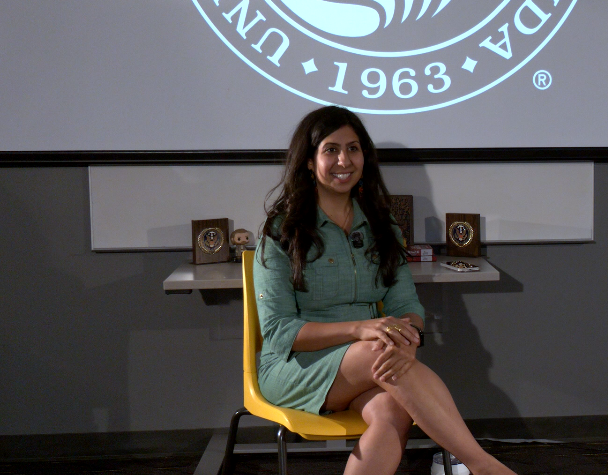
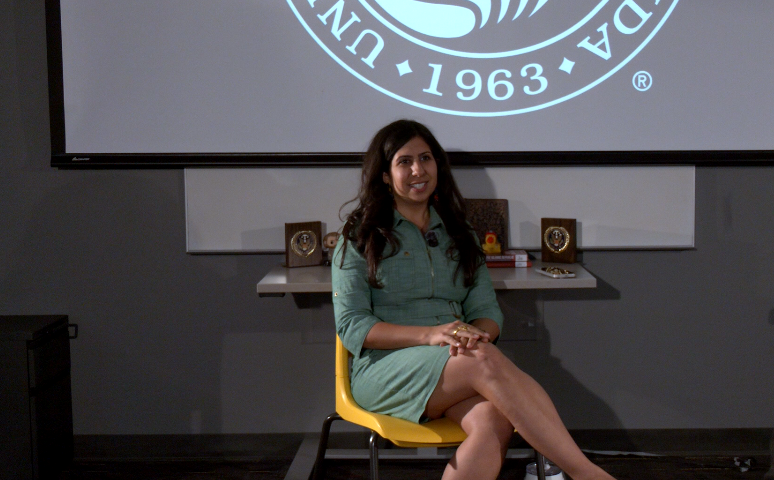
If you asked Orlando mayoral candidate and Florida Rep. Anna Eskamani how it felt to come to the UCF campus a decade ago, the answer would be exactly the same as it is now: like a second home.
Native to Orlando and daughter of first-generation Iranian-American immigrants who fell in love at a donut shop in Orlando, Eskamani's father was the first of three in her family to attend the University of Central Florida in 1994. She was just 4 years old at the time, and to her, UCF was already a place of opportunity, even in a child's mind.
“Coming to UCF was like coming to our playground,” Eskamani told The Charge in a recent interview. “I remember as a child rolling down the reflecting pond and looking for the kids' books in the public libraries and just loving to be on campus with my parents. It really stuck with me as this incredible place of opportunity.”
These opportunities looked a lot different less than a decade later, as in 2004, at the age of 13, Eskamani's mother, Nasrin, succumbed to a hard battle with colon cancer, leaving Eskamani's father to raise three children on his own.
Eskamani said that was the quietest night she ever experienced, that something had been ripped out of her right there at the former Florida Hospital, in the heart of her future district.
“It was this city, it was my schools, it was UCF, that was there as my safety net and wrapped their arms around me to say it was going to be ok," Eskamani said. “It gave me a sense of identity and purpose that I was struggling to find.”
When the time came, Eskamai said she did not even tour other colleges; it was always going to be UCF. She attended the school on a Bright Futures scholarship, but for her, this decision was less about getting a higher education and more about following the path laid out by her father.
It was at UCF that the future state representative found her footing, partly due to on-campus student-led organizations and the sense of purpose they gave her.
“I didn't even know what I would study,” Eskamani said. “It was more just like the next step you do is to go to college. But getting to UCF was transformational as I started getting involved in more campus organizations.”
She ended up working with the Campus Peace Action, the Iranian Student Association, the Green Team, the Arboretum and eventually ended up with the College Democrats. She graduated with two bachelor's degrees, one in political science and one in women's studies, in 2012, yet strived for more in her education. She achieved a master's degree in 2015 in public administration and nonprofit management.
Eskamani said her experiences at UCF have gone on to shape her views on the city's future, as she said she believes that the downtown campus can be a bridge to the rest of the city.
“There's a lot of doors to open and even more doors to make wider,” Eskamani said when asked how her time at UCF would influence her as mayor. “There are already great partnerships we have between the city of Orlando and UCF for arts and culture, so what a great opportunity to expand upon those and make sure every family has access to a stage or an art museum, or a performance.”
Ajeeta Khanna, a UCF alumna, attended the university at the same time as Eskamani, obtaining degrees in journalism and sports business management by 2016. Ajeeta met young Eskamani in 2012 and has stayed in her orbit since, with the representative often placing several late-night orders from Ajeeta's mother-daughter-owned flower shop.
“She has a presence that's both uplifting and grounded," Khanna said. “Having lived in Orlando for the past 32 years, I've had a front row seat to how this city has grown and evolved. In a landscape where many politicians feel disconnected, she is the opposite — she's intentional, responsive, and willing to act."
While obtaining her degrees, Eskamani worked for Planned Parenthood as a senior director of public affairs & communications and a finance director on the campaign to re-elect Rep. Joe Saunders. She also served as president of the Democratic Women's Club of Greater Orlando and UCF’s College of Democrats, was a member of the Orange County Democratic Executive Committee, served with the League of Women Voters of Orange County and volunteered as a Civic Engagement Committee member.
Eskamani said that, originally, she pushed her friends into politics, telling them that they should run for public office.
“[They] looked back at me and asked why I wasn’t running, and that’s what eventually drew me to throw my hat in the ring,” Eskamani told the Charge in 2018.
By 2018, while serving as an adjunct at UCF and pursuing her doctorate, 28-year-old Eskamani took the step from state educator to state leader, as she ran for a seat in the Florida House of Representatives, challenging Republican nominee Stockton Reeves for District 47. She not only won that election in 2018 but also won reelection in 2022 to District 42, while working toward completing her doctoral degree in public affairs and public administration in 2024.
Shannon Fontana, a 38-year-old Orlando native, worked with Eskamani in 2024 on Fontana’s Orlando’s Right to Abortion Rally and was surprised by just how quickly the representative came out in full support of her cause.
“I reached out about her speaking at our event, thinking someone from her team would get back to me,” Fontana said in a message to The Charge. “It ended up being her specifically, which completely surprised me. Warm, friendly, full of energy. She's genuinely all of those things and more.”
That same year, she began her next mission: to define the foundations of the very city that had defined her own path, but now from a position of executive leadership.
In December 2024, she declared her candidacy for mayor in the 2027 election. Nearly three years ahead of schedule, Eskamani has raised over $1 million from 2,000 different contributors while organizing knocks on 45,000 local doors and still serving in the Florida House.
Patrick Burnette, a UCF alumnus and former campaign manager, worked closely with Eskamani during her reelection bid for the Florida House and said that he saw just how hard she was willing to work to achieve her goals.
“She is somebody who is just always working,” Burnette said in phone call. “She goes to great lengths to make sure that she personally responds to every constituent or makes sure that every constituent issue is being resolved.”
Eskmani has a different vision for Orlando’s future, one she said she believes is more committed to its slogan, “The City Beautiful.” In her vision of Orlando, residents can rely more heavily on city resources and data emerging from various higher learning education centers. Eskamani also said she would push to build more SunRail tracks, establish better funding options for public transportation and urge reforms to the tourism and development tax.
“I think her future has no bounds and no matter what role she stays in or moves up to, she will be a mover and a shaker that continues to be a force for positive change in Florida and maybe even beyond,” Burnette said.
Her campaign has refused to accept donations from multinational corporations, instead relying solely on what she calls “thousands of grassroots donors.”
Eskamani’s mission has almost always centered on grassroots work, from organizing petitions in the 5th grade to stop her classmate from being moved classes, to her first independently organized campaign of “Keep PBS in Orlando,” which ended by establishing WUCF-TV as the local PBS affiliate, and her work expanding the Planned Parenthood network throughout Florida.
“Most current elected officials are scared to talk about it, both Republican and Democrat, because they don't wanna upset the tourism industry,” Eskamani continued. “I see the tourism industry as friends; we all care about the success of our region, but I would also argue many of these companies have the resources to promote themselves.”
At the heart of all her campaigns, Eskamani said, is her drive to expand Orlando’s influence and economic viability for future generations. To do this, she said that politicians have to stop focusing on traditional incentives and focus more on quality-of-life improvements for the average city resident.
“I just think when you live in the richest country in the world and in one of the wealthiest areas in the state, that it's a policy choice to allow homelessness to exist, we are allowing it to exist as policymakers,” Eskamani said. “We have so much talent locally and a lot of opportunities to be efficient with our resources and to ultimately solve these problems.”
By Joseph Wiedeman